APPLIED AI GLOBAL PRODUCT LEAD / SAN FRANCISCO

Complex systems.
Human-centered
products.

Building internal AI-assisted products at Google.
Studying data science at UC Berkeley.

Explore selected work

THE WORK

Ideas, built into systems.

01 — 09
01 / APPLIED AI2025 — PresentProprietary

Customer Intelligence & Recommendations

AI-assisted products that turn customer interactions into structured measurement insights and help technical sellers evaluate suitable solutions. Combines customer context, eligibility rules, and expert-validated guidance with LLM-generated explanations.

Conceptual walkthrough

Where does AI help—and where do rules matter?

Customer context, solution eligibility, and a useful explanation answer different questions. Explore the role of each.

Start with the situation, not the recommendation.

Customer interactions become structured measurement insights. That context gives a recommendation something concrete to respond to.

Question this layer answers

  • What is the customer trying to understand?
  • Which measurement needs emerge from the interaction?

Product lens: useful guidance begins with an understandable customer need.

A plausible suggestion still needs to fit.

Customer context helps establish relevance; eligibility rules address the applicable conditions. A solution can sound relevant without meeting those conditions.

Two different questions

  • Relevance: could this address the customer’s need?
  • Eligibility: does it meet the conditions for this solution?

Product lens: a convincing explanation is not evidence of eligibility.

Make the reasoning usable.

LLM-generated explanations accompany expert-validated guidance, helping technical sellers understand recommendations in the context of the customer’s needs.

What the explanation needs to connect

  • The customer’s measurement needs
  • The proposed solution and why it may fit
  • The conditions that matter to the decision

Product lens: the explanation should help someone evaluate the recommendation.

View the workflow outline
  1. Structure customer intelligence
  2. Evaluate solution fit
  3. Explain recommendations
02 / INTERNAL TOOLSIn developmentProprietary

Enterprise Implementation CRM

A specialized CRM in development that connects measurement insights and solution recommendations with enterprise project tracking, stakeholder coordination, and leadership reporting. Builds on the newer AI products, distinct from the earlier core Google Ads CRM transformation.

Connecting insight to implementation

  1. Connect insights & recommendations
  2. Coordinate implementation work
  3. Track projects & report progress
03 / AI SYSTEMS2025 — Present

AI workflow tooling & persistent memory

Morning and evening briefings that bring calendar, email, reminders, and weather into one concise message. Persistent memory carries recent briefings and saved preferences into the next run, while fresh inputs keep the advice grounded in what matters now.

Implemented workflow · fictional example

What should the next briefing remember?

A morning briefing flags a project review and the notes to prepare. By evening, what should carry forward—and what needs checking again?

Bring scattered signals into one decision.

The scheduled workflow gathers current calendar events, unread email, reminders, and weather before asking Claude to compose a briefing. The program owns the sequence of actions.

Fictional morning inputs

  • Calendar: project review at 10 AM
  • Email: feedback requested before the review
  • Reminder: bring discussion notes

Design choice: give the model a bounded synthesis task with current source material.

Make the result fit the moment.

The response becomes a message of up to 1,200 characters, with priority given to useful schedule details and actions. Only after sending succeeds does the workflow save the delivered text to memory.

An illustrative focus

  • Prepare discussion notes before the 10 AM review.
  • Delivery succeeds → remember the final briefing
  • Delivery fails → do not record it as sent

Design choice: remember what reached the delivery step, rather than every draft the model produced.

Carry the context forward. Recheck the facts.

The next run receives the recipient’s three most recent briefings from the past seven days, plus explicitly saved presentation preferences. Current inputs must support any follow-up; a past mention cannot establish that a task is still open or completed.

What persists—and what needs fresh evidence

  • Remember: the earlier preparation focus
  • Keep: a saved preference for short sentences
  • Recheck: whether a response or next step is still needed

Design choice: cap history at 14 briefings, prune old entries, and give the user controls to inspect or clear memory.

04 / CONNECTED DEVICE2026

Commute-aware desk display

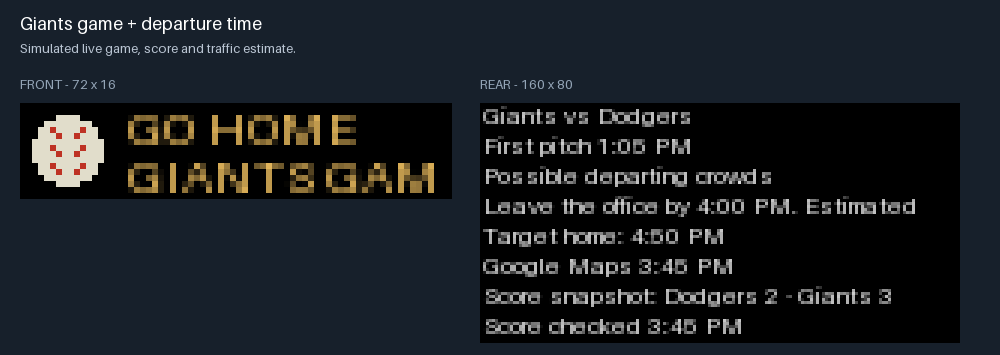
A desk-display app that gathers Giants, Warriors, concert, convention, and street-event schedules before the drive from downtown San Francisco to home. It keeps upcoming events on the bar for quick dial-based browsing, then uses timed priority alerts and provisional departure guidance to help choose when to leave and spend less time in traffic.

Animated BUSY Bar display studies for baseball, basketball, traffic, concerts, conventions, and commute alerts
Animated display studies · Event, score, and travel details shown here use sample data

At a glance

  1. Collect public San Francisco event schedules
  2. Publish a bounded event snapshot over Wi-Fi
  3. Browse upcoming events and surface time-sensitive alerts
05 / BIOINFORMATICS2025Proprietary

Research Data Workflows

A proprietary bioinformatics tool for organizing and analyzing large genomic datasets. Streamlines data processing and repeatable analysis to support research across complex biological data.

At a glance

  1. Organize large genomic datasets
  2. Support repeatable data analysis
  3. Streamline bioinformatics workflows
06 / HEALTH DATA2025Private repository

HealthCharts

Personal health data platform synthesizing wearable telemetry and lab panels into actionable visual trend analytics.

At a glance

  1. Wearable telemetry
  2. Lab panels
  3. Trend analytics
07 / DATA SCIENCE2025Private repository

Global Happiness

Full-lifecycle exploratory data analysis, Quarto publication deck, and interactive dashboard modeling well-being indicators.

At a glance

  1. Explore
  2. Model
  3. Publish
08 / CIVIC DATA SCIENCE2025

Smart Streets, Faster Fixes

Designed a proposed cluster-randomized study to evaluate whether vehicle-mounted LiDAR could improve road hazard detection, reduce manual inspections, and support more equitable street maintenance in Oakland. Combines operational measures with resident surveys on safety and fairness.

Research proposal · no study results claimed

What would the study test?

The proposal asks whether vehicle-mounted LiDAR could improve hazard detection and street maintenance in Oakland. Compare the approaches, then explore what success would need to mean.

Compare LiDAR detection with OAK311.

The proposed design establishes a baseline and randomizes road clusters. The comparison asks how a different detection approach might change maintenance work.

Proposed comparison

  • Vehicle-mounted LiDAR: another way to detect road hazards
  • OAK311: the reporting comparison named in the proposal
  • Road clusters: the proposed unit of randomization

Research lens: detecting more hazards alone would not establish that maintenance improved.

Follow detection through to practical work.

The proposal considers better hazard detection and fewer manual inspections. These are questions to evaluate, not demonstrated benefits.

Questions for the proposed evaluation

  • Does hazard detection improve?
  • Can the approach reduce manual inspections?
  • Does better information support street maintenance?

Research lens: distinguish a promising detection method from evidence of operational improvement.

Ask whether improvements are felt fairly.

The mixed-methods proposal includes resident surveys on safety and fairness alongside operational measures. That broadens the evaluation beyond what sensors can observe.

A second perspective on success

  • Operational measures: what changes in the work?
  • Resident surveys: how are safety and fairness perceived?
  • Equity: does the approach support more equitable maintenance?

Research lens: operational performance and resident experience answer complementary questions.

View the workflow outline
  1. Establish baseline & randomize road clusters
  2. Compare LiDAR detection with OAK311
  3. Evaluate operational outcomes & resident perceptions
09 / PERSONAL AUTOMATION2026Private repository

Packing Assistant

A reusable packing system that turns trip duration, destination needs, and modular templates into personalized checklists. Scales item quantities, preserves packing progress, and uses AI-assisted post-trip reflections to improve future lists.

A checklist that improves between trips

  1. Combine trip details & reusable templates
  2. Generate a tailored packing checklist
  3. Refine future lists with post-trip feedback

BACKGROUND

A seller’s perspective.
A builder’s mindset.

I bring a seller’s perspective to building AI products. Before moving into product leadership at Google, I worked directly with small businesses and enterprise customers on growth strategy, digital advertising, and technical integrations. That experience shapes how I connect customer needs with products people can adopt and use.

I lead internal products in Google’s Global Business Applied AI organization. My work began with a multi-year transformation of the core Google Ads CRM: bringing workflows closer to real customer interactions, from initial design and engineering partnership through global rollout and adoption.

Since 2025, my focus has expanded to AI-assisted measurement intelligence and solution recommendations. Those products are launched; I’m now developing a specialized CRM that connects their insights with enterprise implementation work. Across both chapters, I bring a seller’s perspective to making complex tools more useful.

I’m completing my Master of Information and Data Science at UC Berkeley. My technical work spans research data workflows, data science, and web development, with a focus on turning complex AI systems into dependable, human-centered products.

View résumé

September 2022 — Present

Google · Global Business Applied AI

Applied AI Global Product Lead

Led an earlier multi-year core Google Ads CRM transformation from design and engineering delivery through global rollout. Since 2025, expanded into AI-assisted measurement and recommendations, now launched, with a specialized implementation CRM in development.

In Progress

UC Berkeley School of Information

M.S. in Information and Data Science (MIDS)

Graduate studies focused on AI Product Management, applied machine learning, statistical modeling, and data ethics.

March 2020 — September 2022

Google · Large Customer Solutions

Senior Account Manager · Apps

Managed a major enterprise customer relationship across Google Ads. Partnered with marketing and innovation teams on growth strategy, new-product testing, media planning, and custom technical integrations. Brought customer feedback into product teams and led sales operations improvements.

January 2019 — March 2020

Google · Customer Solutions

Account Strategist

Advised small and medium-sized businesses on Google Ads, digital strategy, and web and mobile performance. Supported sellers with YouTube and app campaign expertise, mentored new teammates, and contributed frontline feedback to sales tool development.

June 2016 — December 2018

Clarkston Consulting

Consultant

Worked across life sciences and digital commerce on supply-chain strategy, operational analytics, and business readiness for enterprise systems change.